
 In my first memories of Uncle Charles, he’s home on leave looking sharp in his sailor uniform. Aunt Dee treasures the flag that draped his coffin and the World War II story told at his funeral.
Married for ten years and living in Florida after the war, Aunt Dee and Uncle Charles Maxson welcomed her younger sister Ruth for an extended visit. Aunt Dee had volunteered to make Aunt Ruth’s wedding dress, and fittings were necessary.
The prospective groom, soon to be my Uncle Leo, came down for a couple of days to see Aunt Ruth and meet more of his new family. At the supper table, Uncle Leo and Uncle Charles eyed each other with a wary, “Haven’t I seen you somewhere before?”
Bit by bit, they reconstructed their pasts, discovering that each had served in World War II. By the time they got to the fact that Uncle Leo’s ship had docked in the Pacific for repairs, Uncle Charles exclaimed, “You’re the guy who tracked mud across my newly waxed floor!” Uncle Charles, assigned to the unit doing ship repairs, had been proud of his floor that rivaled the spit shine of his shoes! It was a Baptist funeral so they did not repeat the words Uncle Charles used in his reprimand to the young serviceman with the muddy shoes, but they were evidently words I had never heard him say.
The two men mended their fences and became brothers-for-real as well as brothers-in-law, beginning with a bond they shared of honor and service to their country that overshadowed mud tracks on a newly cleaned floor.
I enjoyed our church’s early Memorial Day celebration that was more than a picnic as we paid honor to those who had served their country in various military branches by calling out their names. My thoughts  were on two men who were part of what Tom Brokaw called “The Greatest Generation” – men who met half a world away, married my mother’s sisters, and became my Uncle Charles and Uncle Leo.
Mentors or Peeps?
 Definitions for “peeps” as a shortcut for associates or friends cite slang and Internet use. One goes on to editorialize that she dislikes the term and hopes the word is short-lived. Real usage seems to include a layer that indicates a very close connection between members as signified in the expression “my peeps.” I have peeps who also serve another role.
For about fifteen years, I’ve been active in the monthly critique meetings of Louisiana SCBWI [Society of Children’s Book Writers and Illustrators]. I thought of them this week when this quote turned up on A.Word.A.Day:
"Just as mentors come in different shapes and sizes, they fill different roles. Ms. Brooks said the common denominator is that they are good and active listeners willing to offer constructive, but blunt, criticism and, at the same time, share stories about their own failures." Mark Evans; Age No Barrier; Globe and Mail (Toronto, Canada); Mar 30, 2012.
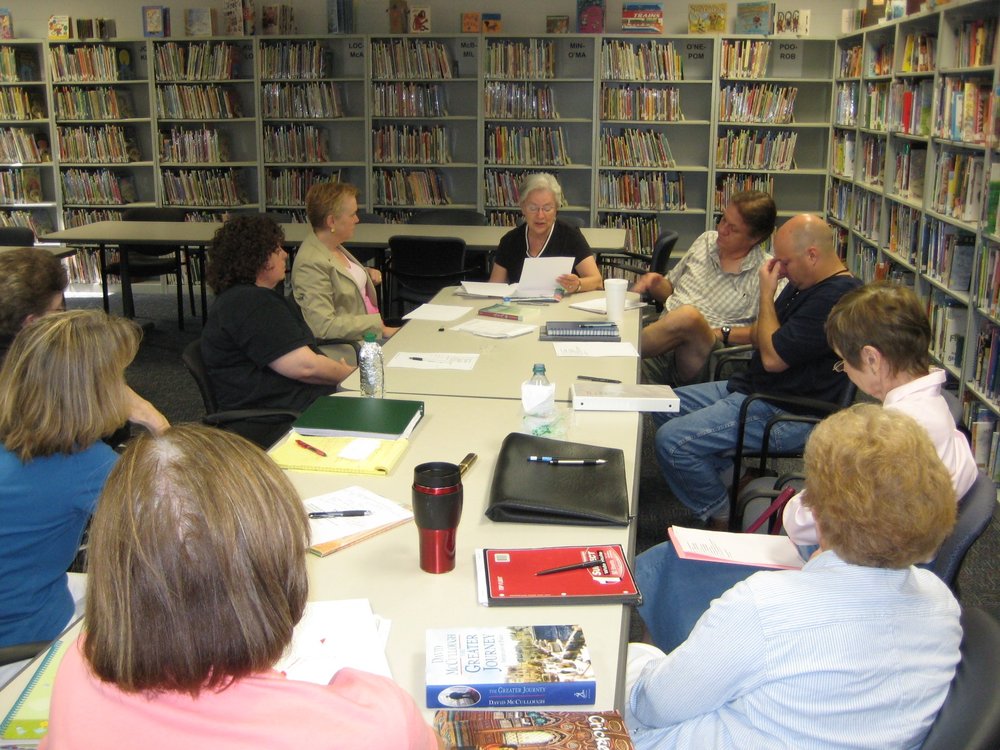
Check the picture taken at a monthly meeting and you can see some of the physical differences of my mentors, but variety goes beyond what you see. My mentors come from different political and religious persuasions, different marital and family statuses, and different cultural backgrounds. Trust me, they are good and active listeners.
They play different roles in this listening. Ears on one are sensitive to overly repeated words, and she is quick to suggest good synonyms. Another spots plot inconsistencies. A third says, “Scrap your first chapter. The story starts in the second.” All pronounce the death sentence on “ly” words.
But my peeps go beyond critiquing as they share rejection letters and sad stories or rejoice over acceptance or even near-acceptance. Without fail, they reassure the writer, suggest rewrite options, and offer ideas about which editor or agent should be the next recipient of the manuscript.
My mentors may not even realize they also furnish motivation to stay on track. Lollygagging in the yard, checking Facebook, or stirring up a batch of cookies seems pretty reasonable to me until the meeting date looms on the calendar.
I know the question I will face. “What are you working on?”
“Nothing,” doesn’t seem to be an acceptable answer.
Mentors or peeps? Actually, both. Thanks, Peeps.
Candles . . . Quilts . . . Books
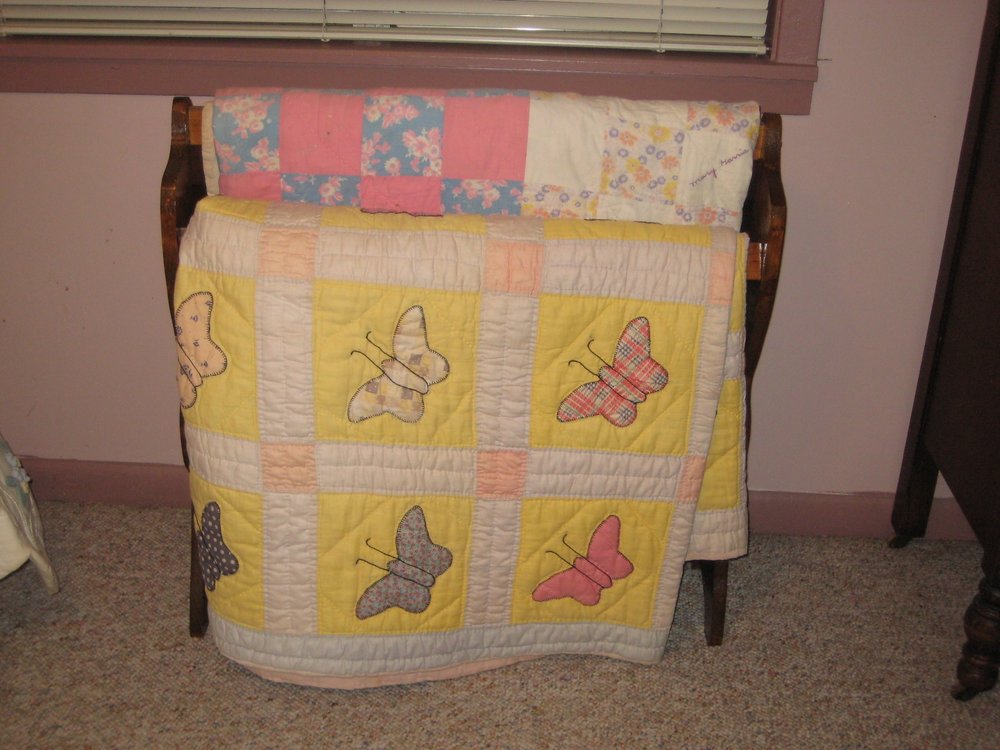 The candle connection metaphor began for me with friend Martha Ginn’s fiber art quilt presentation. She pointed out the proliferation of candles and quilts, both necessities in days gone by, now used in homes for beauty and atmosphere.
Coincidentally, I came home to read Roger Sutton’s editorial in the May/June 2012 Horn Book Magazine. He used a comparison, which he in turn borrowed from Eli Neiburger, of book publishing as being akin to the candle industry. He says both candles and 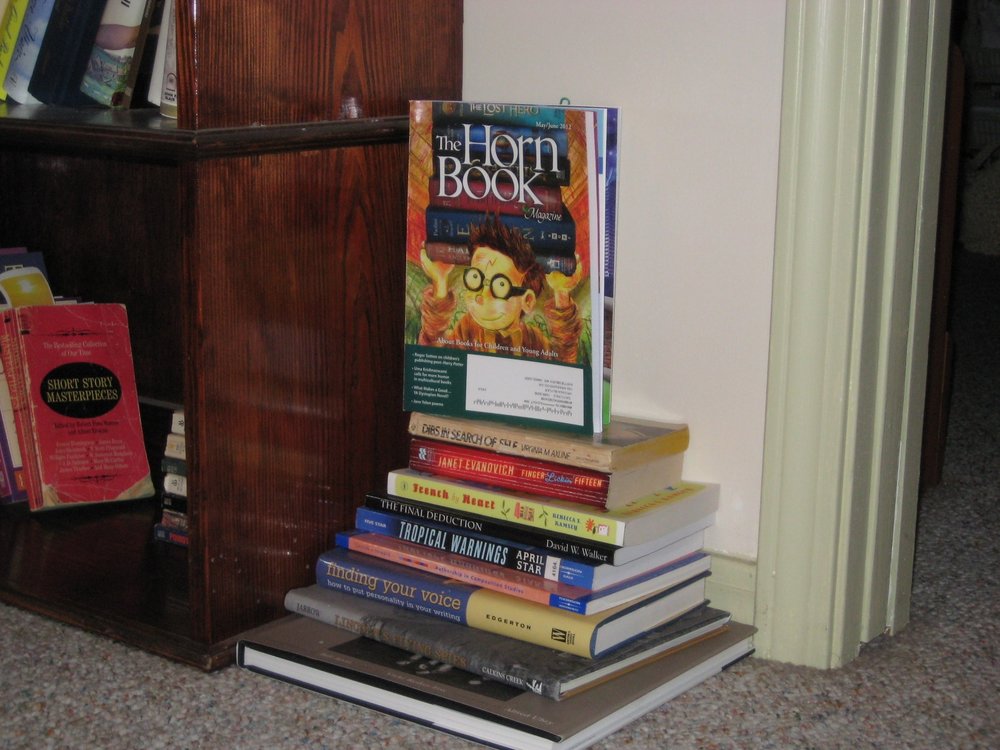 books are utilitarian as well as glamorous; may be the center of attention or shine light on something else; may be life-saving or dangerous; and frequently one serves to light another. He points out that with candles and printed books, we can still read if the lights go out forever.
I’ve enjoyed personalizing Martha’s and Roger’s metaphor. I have a drawer that holds candles for emergencies if the power goes out and seasonal ones for decoration. A heritage of quilts, many lovingly stitched by ladies in rural churches as gifts for my parents, provide cover for a good night’s sleep or hang beautifully from my husband’s handmade quilt rack. Assorted stacks of books occupy my house, some needing to be read and others awaiting free time fun reading.
And I’m thinking if the lights go out on a cold winter’s night, it’s not going to be that bad. I can always light a candle and read a good book snuggled up in one of those quilts.
About Those Wild Things
 I’ll get my two part confession out of the way first. (1) I never read Where the Wild Things Are to my students. My reason is the second part of the confession. (2) I didn’t like it. Early in my teaching career, I heard a sound piece of advice in a workshop. The presenter said, “If you don’t like a book, choose something else to read aloud to your students. They will pick up on your negative feelings.” So I chose to read aloud other Maurice Sendak books that I liked. There were plenty to choose from.
My students shared my love for Pierre: A Cautionary Tale, giggling at its absurdities and feeling very superior to the brat who answers everything with “I don’t care,” including the lion’s suggestion that he could eat Pierre.
We started every new month with a poem from his Chicken Soup with Rice: A Book of Months. A sample to get you ready for June: 
In June
I saw a charming group
Of roses all begin
To droop.
I pepped them up
With chicken soup!
Sprinkle once
Sprinkle twice
Sprinkle chicken soup
With rice.
Now I had no personal quarrel with the wild things and was shocked to find among Ezra Jack Keats papers an exchange in the March 1969 Ladies Home Journal. In the previous issue, an expert pediatrician had a conversation with three irate mothers in which they denounce the book as being too damaging to children’s psyches. Keats had written a scathing letter to the editor defending the book and berating the physician who had admitted that he had not read the book. The magazine published Keats’ letter along with a lukewarm semi-apology from the pediatrician who claimed to have come to his original conclusion after he read the book before the article actually went to publication. Shame on him and hooray for Ezra!
I joined the multitudes in the book world in feelings of loss when the news came of Sendak’s death last week – not just for his own books but for the gazillion or so that he illustrated.
My own feelings about Where the Wild Things Are remain unchanged. (Sorry about my taste. While I’m confessing, I also hate Moby Dick.) But I’m very glad I didn’t pass that feeling on to my students. I have good memories of looking back after a trip to the school library with my class and seeing a reluctant second grade reader sitting at his desk absolutely lost with Max and the Wild Things. So glad I didn’t spoil it for him!
Mama's Cooking Lessons
 Daddy’s eyebrows jumped all the way up to the double deep inverted V of his hairline when I said, “Mama did a good job of teaching me to cook.” To understand his surprise, you have to know a bit about Mama’s relationship with the kitchen. Things she cooked well were:
• Cobbler – with any kind of fresh fruit
• Chicken and dumplings
• Chocolate covered cherries (only at Christmas)
• Cookies
• Biscuits
That’s about it, and I’ve used only one hand to count. Now she was adamant that meals were balanced and healthy to the point that when I needed to remember one more of the seven basic food groups for a home economics test, I only had to go through our menu for the previous day to find it. The food just wasn’t what my brother-in-law would call “tasty.”
When I was nine, I suggested that I might learn to cook. Even then, I favored “tasty.” Mama jumped on the idea like a duck on a June bug and handed me a cookbook. I knew where everything was in the kitchen from years of dishwashing duty. She told me where she would be working if I needed her and left me with the run of the kitchen.
I didn’t need an advanced degree to know I was better off with the cookbook than her advice so she was rarely disturbed. The plan worked to perfection since I was happy in the kitchen and she was happy out of it. Waiting for pots to boil and sauce to thicken, I even found a new source of reading material – cookbooks!
As I’ve thought about Mama on this Mother’s Day weekend, it has occurred to me that Mama taught me many other things in the same way she taught me to cook. She gave basic information, pointed out resources to use, offered her availability if needed, and then trusted me to figure out the process and add my own stamp to it. It’s not a bad parenting model.
Waiting for the Train
 What kid doesn’t love a train? My early four-year-old love for trains got my fifteen-year-old aunt in a peck of trouble. Her assignment was to sit with me in church while Daddy preached and Mama sang in the choir. Daddy tolerated a lot of things, but had no patience with Aunt Ruth’s intermittent fits of giggles that ran throughout his sermon. He took her to task as soon as we got home. “Berton, I couldn’t help it,” she said. “Virginia Ann knew the first two hymns and sang along. She didn’t know the last one, so she sang ‘Chattanooga Choo Choo’ instead.”
Phase Two of my love for trains came in our next home in Hardy Station perched atop a hill that was slashed in two for the train track. [Note the train reference even in the name of the village.] Train whistles day and night and the ground shudders accompanying them were lullaby and rocking chair for a good night’s sleep. We watched daily for the train that swung a heavy bag of incoming mail onto the hook while it lifted the outgoing bag. One engineer, a longtime friend of my parents, blew his whistle as he passed if he saw one of us out on the rope-and-board swing hanging from the oak tree.
Fast forward many years to my husband’s Army assignment in West Germany before the fall of the Berlin Wall. Our family traveled on the train through the night for a visit in Berlin. We woke up as the glide of the tracks became a rumble traveling the miles over rough track through East Germany. Having become accustomed to West Germany’s trains that went everywhere and ran on time, I had to rethink my reaction when I traveled home for my father’s funeral and found myself stranded in the Atlanta airport. A January ice and snow storm covering the South grounded planes flying west of Atlanta and left me with little hope of getting to Mississippi. My first thought was, “It’s okay. I’ll go downstairs and take the train.” Then I remembered I wasn’t in Germany any more.
Partial redemption for this American shortage has come in our move to Hattiesburg, although my husband insisted that we not buy a house anywhere near a railroad track. The noises do not say “comforts of home” to him. Hattiesburg’s newly refurbished depot beautifully hosts exhibits and community events. And they still sell tickets to exotic places like Birmingham where I can visit my sister Beth. The train trip takes about the same time and money as the drive with seating that is spacious and comfortable. I take some reading, some writing, some cross stitch (no ‘rithmetic), and enjoy my journey.
Tomorrow, May 12 is the fifth National Train Day. If you are also a train lover, find local events at www.nationaltrainday.com. I’m celebrating by imagining an American rail system where passenger trains go everywhere and run on time and travelers waiting for the train sing “Chattanooga Choo Choo.”
Writing a Garden or Gardening a Story?
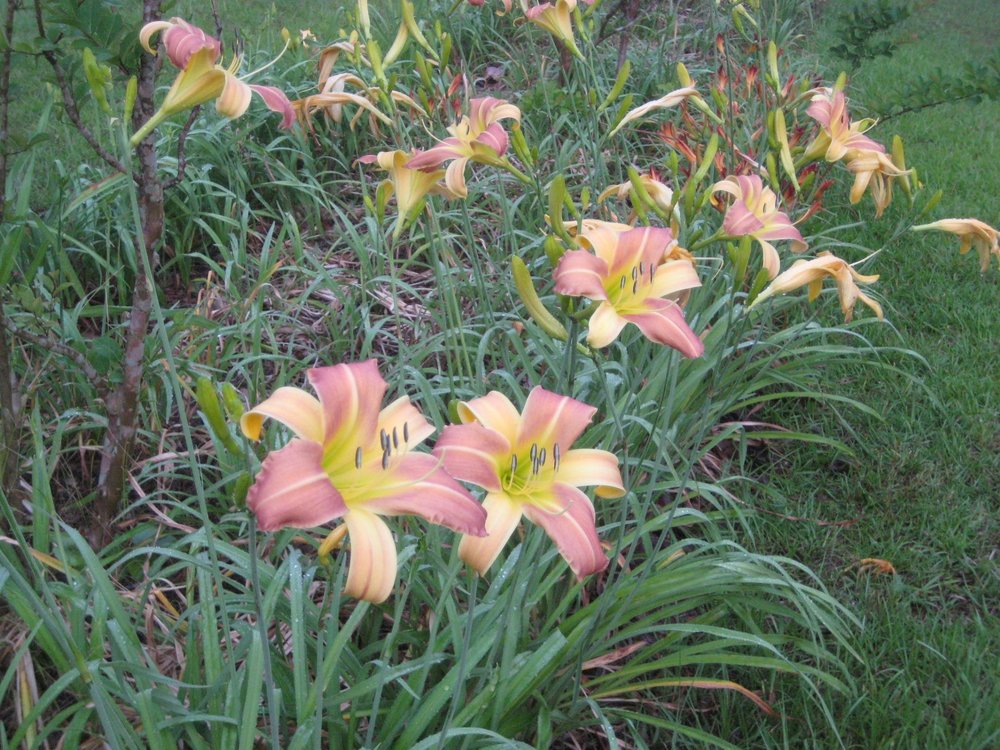 Flowers sprout all through the stories of Mississippi writers Eudora Welty and William Faulkner. Eudora Welty didn’t stop with sowing flower seeds into her settings. She often used their names for her characters. My sister and her fellow garden club members in New Albany, MS tend a garden devoted to flowers mentioned in Faulkner’s works at the Union County Heritage Museum. Both the museum and garden are worth a visit if you happen to be up that way.
Having observed the writing-gardening connection, it seemed to me that I could lose my “black thumb” reputation with my children when we moved back to Mississippi almost eleven years ago. The previous owners of our house left me with a good start but a different gardening philosophy. They were laid-out-formal-garden people and shaped-up-shrub-trimmers. My plan includes minimal pruning while maintaining natural shapes and allowing any plant that pops up to stay if I like it. The shaped up shrubs are long gone. My hodge-podge cottage garden suits me fine. I invite you for a short tour.
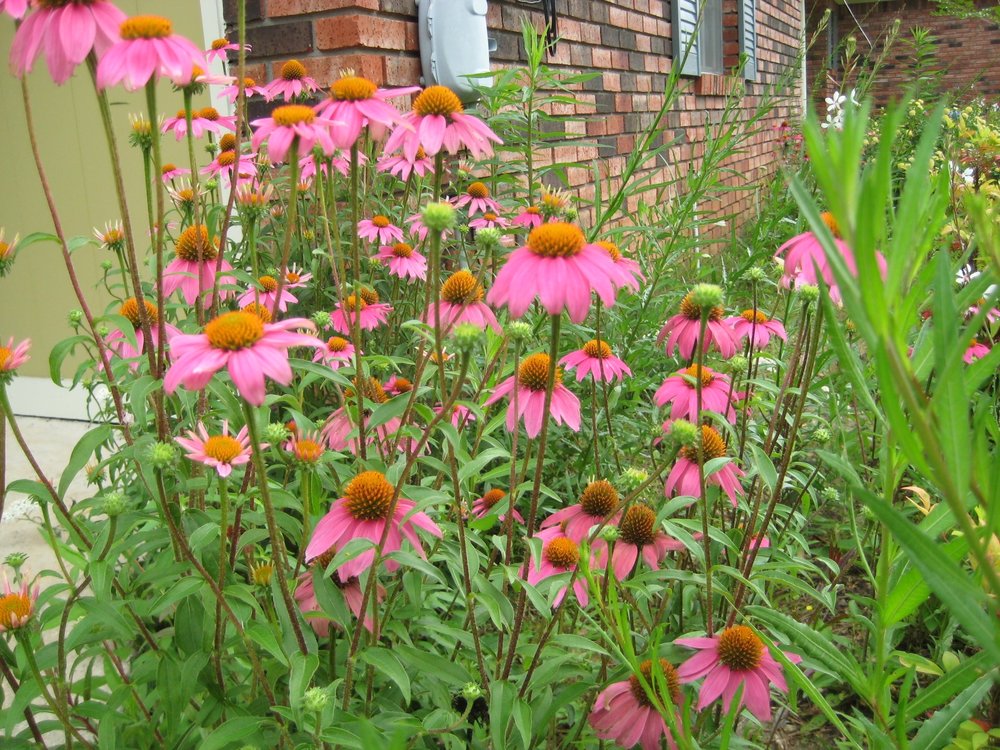 Whoever named these plants “purple” coneflowers had to be colorblind. A more accurate description would be hot pink. Also know as Echinacea they are touted as a remedy for colds. I can’t vouch for that, but I like them because they reseed and bloom beautifully with no effort on my part.
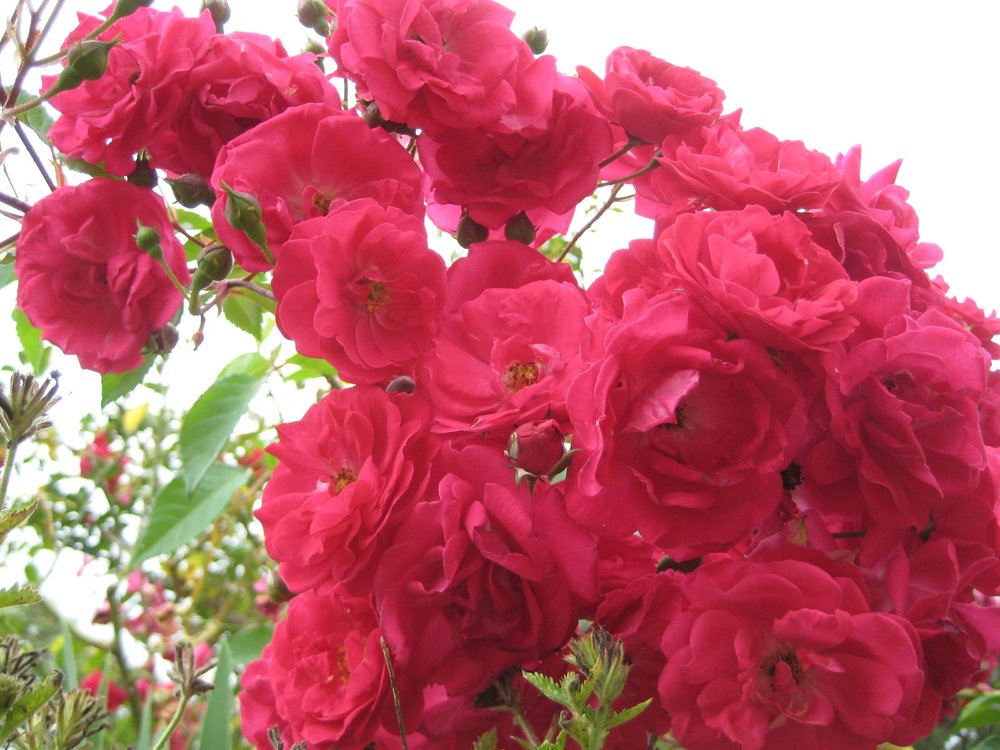 This rose came from a cutting I rooted from my mother-in-law’s bush. This heavy cluster, one of many covering the bush, took a strong stem almost to the ground, forcing me to take the picture with the camera underneath the blooms. It’s heady fragrance fills the yard.
 Queen Anne’s Lace, often considered a weed, brings back memories and blooms wherever it wants with my permission. My mother and sister-in-law gathered it from pastures and road ditches for filler for Mama’s flower arrangements in tall white wicker baskets for my wedding.
 Black-eyed Susans – I know these are wildflowers, but who could pull up anything this cheerful?
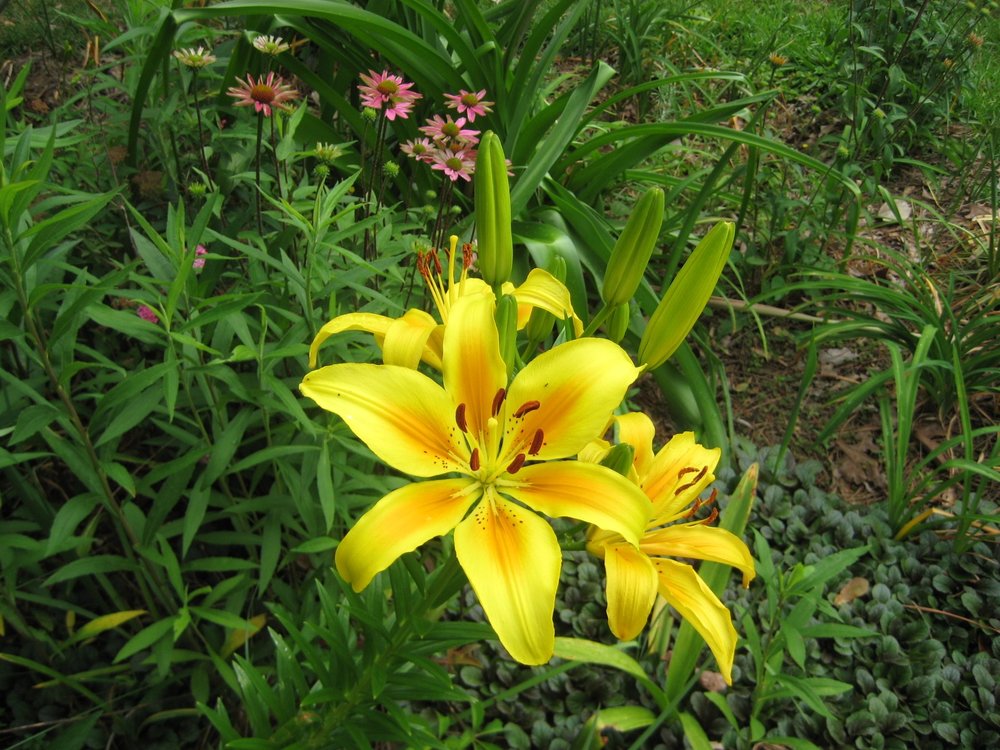 Occasionally, I actually buy a really truly bulb such as this in a garden store. It blooms quite happily alongside the passalongs and wildflowers.
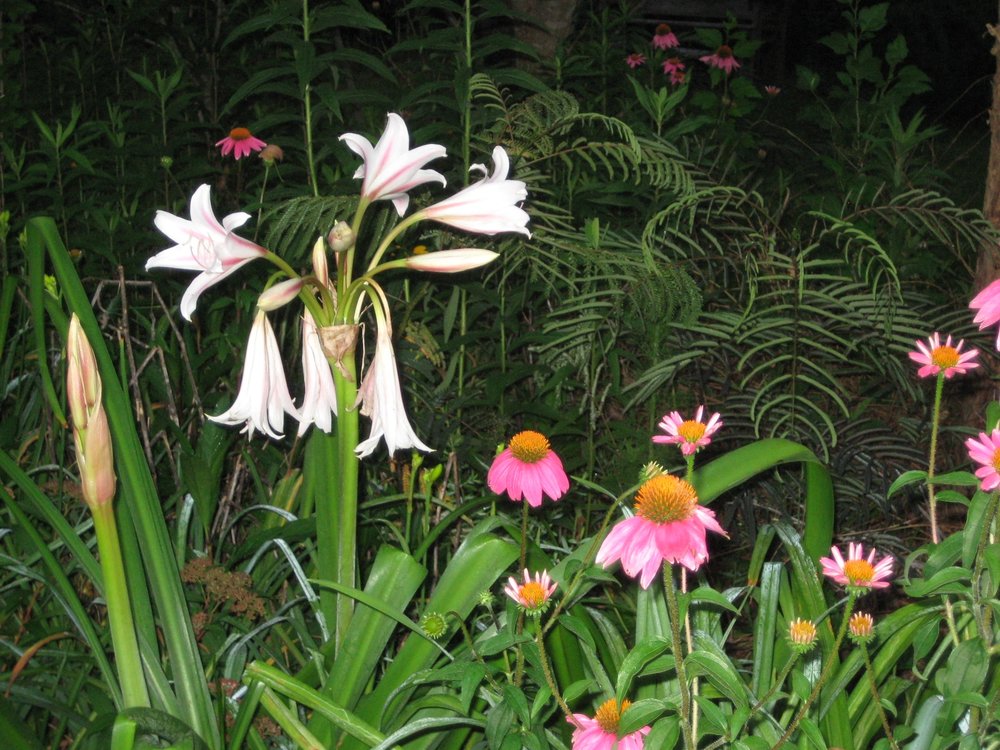 This common milk-and-wine lily or crinum was always known to my sisters and me and then to my children as “Papaw’s Lilies” because they lined the side of his house. In true Mississippi writer fashion, these lilies became a crucial part of my story “Rags and Riches” in the September 2011 issue of Cricket Magazine.
My gardening plan has worked to the extent that my children now look for other items to ridicule besides my gardening skills. Something beautiful is always about to happen in the yard even through the winter with its abundance of red-berried hollies and nandinas.
As for the writing, I find that words that were blocked in my head come unstuck along with the weeds I pull.
Librarians on the Loose
 When someone says “librarian,” do you picture a bespectacled, bun-in-hair, unmarried woman running around saying “SHHH”? Maybe you know all the words to “Marian, the Librarian” and picture Shirley Jones in The Music Man.
Check out the pictures in this blog to see what librarians really do when nobody is looking. These were taken at the gathering of better than 350 people, predominantly librarians, at the Faye be Kaigler Children’s Book Festival. I’ve added a short list of other things they do that come readily to mind.
- Match new books to patrons who will “just love this one”
- Locate books for interlibrary loans
- Work hand in hand with classroom teachers to enhance education and children's love of books
- Teach technology challenged adults to download books loaned to their electronic reading devices
- Lead book clubs
- Provide computer access for those who do not have it at home
- Plan engaging summer programs for kids through adults
- Read banned books: To Kill a Mockingbird, Harry Potter, Bridge to Terebithia, Gone With the Wind, the Bible, etc.
- Defend banned books – for firsthand accounts read True Stories of Censorship Battles in America's Libraries edited by Kathy Barco and Valerie Nye, a collection of essays, some by children's librarians

I could go on but I must get back to the librarian stereotype. At the festival, I did see several who were bespectacled – they read extensively after all. They were single, married, or divorced. Some had children or grandchildren, and some were childless. I did not see one bun in the crowd of librarians, and nobody said, “SHHH”.
I close by asking you to do two things for me as a personal favor:
1. If you see a librarian this week, just say thanks.
2. Please don’t tell my librarian friends that I ratted them out with my pictures. I’d hate to lose my status with the Children’s Book Festival. 
Pocket Poem
 Poet Rebecca Kai Dotlich hooked me at the start of her Children’s Book Festival presentation beginning with her “Where Does A Poem Start?”
In the middle of August,
halfway to nowhere
six steps from the moon,
in the barely there
curve
of a spoon…
Her gentle voice reeled me in as she laced her presentation with her poems and joy of writing. I was firmly caught when she got to her book Bella and Bean with the two friends of opposite interests: Bella who wants to hole up and write poems and Bean who wants to be out and about. The book’s charm was complete when I read it in light of her explanation that she was Bella, and her husband was Bean. He called to her upstairs office window to come out and see his work in the yard, but she resisted as inspiration for a poem held her in its grip. The relationship’s resolution comes on the last page with its final poem. A charming picture book for kids turned into a warm fuzzy for this adult.
Her presentation took me back to a favorite poetry experience. When I taught second grade, once we got the notes from home and lunch count attended to, our day began with a poem: “Casey at the Bat” for baseball season; “Some One” at Halloween; and “Stopping by the Woods on a Snowy Evening” on Louisiana days when we wished for snow. Favorites were repeated with student requests balanced with teacher choices. The children soon memorized a favorite by Beatrice Schenk de Regniers from the repetition. It begins:
“Keep a poem in your pocket and a picture in your head
and you’ll never feel lonely at night when you’re in bed.”
We didn’t analyze or discuss excessively – just enjoyed. One day Jennifer Fuller came up to my desk and said, “I have made up a saying.” Her “saying” became the theme for a poetry bulletin board, and I used it every year thereafter in second grade:
A POEM A DAY KEEPS THE GROUCHIES AWAY
Maybe Jennifer was onto something. Do you have the grouchies? Pull a poem from your pocket. I think Rebecca would approve.
Luddite Leanings
 Hannah learning to do ribs from Uncle Murray14-year-old granddaughter Hannah looked up from their supper table and said, “I don’t understand that clock.”
I was a bit puzzled since I’d been admiring both its beauty and the musical hour chime until I noticed the numbers. “Don’t they teach you Roman numerals these days?” I asked.
Son Mark kicked in with the real explanation, “Mom, she knows Roman numerals. She means she doesn’t understand the clock face. She’s used to digital clocks.”
I can’t really fault Hannah since I have equal difficulty going the other way. She raises her eyebrows when I profess pride in learning a bit of technology that is old hat to her. I’ve just headed toward the twenty-first century with the purchase of a Kindle and am facing moments when I want to say, “I don’t understand this kind of book.” I’ve held out in the face of friends and family who’ve espoused its advantages, pleading a love of turning pages and holding a book in my hands. Hannah’s had hers since Christmas and didn’t consider learning to use it a big deal.
As I’ve been prodded or coerced to learn to use a computer, I’ve sympathized with nineteenth century Luddites who smashed the machinery causing their problems. Taking a sledge hammer to my computer has occurred to me more than once. And I still own a dumb phone with no texting. However, time for change does come.
Three recent trips convinced me to take the plunge. On the first trip, I wagged a bunch of heavy books to be sure I didn’t run out of reading material before I got home only to leave two unopened and unread. The second trip was worse since I didn’t take enough books and would up with two days left on the trip with nothing to read. On the third trip at Easter, daughter Anna insisted that I read on her Kindle to check out its ease of use. She also touted the number of free classics to be ordered, knowing I was a sucker for rereading the ones introduced to me in high school by Mrs. Bounds. Thinking of my estimate errors on the number of books to take and looking at travel time for the summer, I decided it was time. I am now the proud owner of a Kindle – still working on complete understanding of this kind of book. 
I think I shall always love a book with pages to be turned and a place on my bench in the shady nook of my yard with a glass of iced tea. But on our last trip, I did enjoy the security of having six books on cue to be dialed up as the Kindle slid into my purse taking up less space than my spiral steno pad.
In her speech at the recent Children’s Book Festival, Jane Yolen said that our ways of reaching them may change but what has always been and what will remain are the stories. I’ll vote for that.
Lingering Legacy
 Nicola Winstanley, Meg Medina, Jenny Sue Kostecki-Shaw, and Micha ArcherIn this 400th anniversary year of the King James Bible, lists proliferate of expressions taken from the text that have become part of our language. This last week as I watched the awarding of the Ezra Jack Keats Awards for New Writers and New Illustrators of children’s books, one of my favorite phrases became an ear worm [see “There’s a Name for That” blog]. Over and over, my thoughts repeated, “He being dead, yet speaketh.”
Before his death, Ezra Jack Keats and his close friend Martin Pope established the Ezra Jack Keats Foundation to continue support of schools, libraries, writers, and illustrators who promote the universal qualities of childhood and supportive families in a multi-cultural world. One aspect of this goal is the annual award for new writers and illustrators whose books exemplify these ideals. The celebration moved this year to the Book Festival right here in Hattiesburg with honorees whose works met that criteria:
• Writer Meg Medina with her childhood memory turned into an engaging picture book with Tia Isa Wants a Car
• Writer/Illustrator Jenny Sue Kostechi-Shaw with her penpals from opposite sides of the world inspired from her own time in Nepal and India and her title reflecting an expression she heard often there – Same, Same but Different
• Writer Nicola Winstanley with her charming fable of Cinnamon Baby who does nothing but cry until…
• Illustrator Micha Archer whose dancing skirts seem to swirl right off the page in Lola’s Fandango
The award celebration seemed magical with more than one of the recipients overheard saying, “feel like a princess.”
My mind’s eye pictured Ezra smiling in a corner with button-popping pride in these excellent examples of his lingering legacy.
In Debt
 One of my favorite pictures of Gwyn with her granddaughter Mary Hannah taken by my photographer granddaughter Lauren DamiskinosI’ve always told my sister Gwyn that she owed me. Luckily for her, I was there on the day she was born. Third of the McGee girls, she has a birthday tomorrow. She was born at home just like the first two of us. Along in the afternoon, a five-year-old neighbor came from down the street to see the new baby. We’ll call her Mary Ann since I don’t remember her name but know she was Southern and needs a double one. She was on a mission.
After finding the new baby satisfactory, Mary Ann said to my mother, “Mrs. McGee, since you already have two girls, and I have two brothers, why don’t I trade you one of them for this new girl?”
Before Mama could think of an answer that spared the child’s feelings, she said I pulled myself up to my full three-and-a-half-year-old height and said, “No, sirree, that’s my little sister.” Clearly without me, Gwyn might have wound up in some other family.
That’s not all she owes me, although I admit to being a little slow on the uptake on this next one. In our teenage years, I liked to sew, and Gwyn liked to wear pretty clothes. She would come in with two patterns and her best manner as though she was doing me a favor and ask, “Virginia Ann, which one of these would you rather use to make me a new dress?” Tom Sawyer could have taken lessons from her. By the time I figured out that I was the one doing the favor, she looked so good in the new dress that I didn’t care.
In adulthood, the one in debt has switched. Mama aged and moved close to Gwyn, making her the primary caretaker. Gwyn’s consistent loving attention as Alzheimer’s Disease robbed Mama of herself has left me in a debt that could only be resolved by my declaring bankruptcy.
So when she asked me to make 200 of my homemade sandwich rolls, a favorite of her daughter Sallie, for Sallie’s wedding reception, my answer was, “Of course.” [Like her mother, Sallie looked wonderful in the wedding dress and made it worth my while.]
Tomorrow, I hope Gwyn has a happy birthday and knows that I consider keeping her in the family as one of the major accomplishments of my life.
Green, Green, Green
 Green gets a lot of publicity, most of it good.
• The grass is greener on the other side of the fence.
• Green, green, it’s green they say on the far side of the hill. Green, green, I’m goin’ away to where the grass is greener still.
• Even when Kermit the Frog sings his lament, “It’s not easy being green,” he ends with “I am green and it'll do fine, it's beautiful! And I think it's what I want to be.”
• Environmentally, we pride ourselves in “going green.”
• We look forward to things greening up in the spring.
But then there’s green with envy. Not too many things make me envious, but I met Susan Haltom a few months ago when she came to sign her book One Writer’s Garden at a lovely lunch provided by Main Street Books, our local independent bookstore. The title is a play on words from Eudora’s biography One Writer’s Beginnings. I must admit I had to shush the green-eyed monster as she described her time sitting with Eudora Welty and chatting for real instead of being in my imaginary seat. [See “Moving Closer to Eudora Welty” blog.]
As I listened, the monster disappeared to be replaced with gratitude at what Susan and her posse rescued. Even Pulitzer prizewinners are not exempt from the aging process. As Eudora’s body began to fail, her lovely garden felt the pains of neglect. Tangled weeds and bushes replaced flower gardens carefully planned by Eudora’s mother Chestina and maintained by Eudora when she needed a respite from writing. Both Eudora and her neighbors mourned its loss. Enter Susan, garden designer and preservationist and her entourage.
Susan sat with Eudora to get the garden details and wound up with so much more. They did restore the garden and had many additional conversations that gave Susan a story that wound up becoming what appears to be a beautiful coffee table book. It is that and more. There’s a history of the intertwined lives of the garden and the two women who tended it. There’s the stunning floral photography of Langdon Clay and Susan. And there are the Welty family album pictures.
No longer green, I will read the whole fascinating story again – and will often pick up the book to read a page or two or gaze at a beautiful flower that only needs a smell to become real. If you love Eudora Welty, beautiful gardens, or family histories, you need the book.
Moving Closer to Eudora Welty
 My jasmine connection with EudoraOnce upon a time, I claimed I was one degree removed from Eudora Welty. I confess I stretched to find that connection to Eudora – Pulitzer Prize winner and arguably Mississippi’s best known female writer. My mother worked in north Mississippi as Oktibbeha County recreation director under the auspices of WPA. At the same time, Miss Welty was writing stories and taking pictures across the state as a WPA reporter, burning images in her mind and heart as well as in the photographs – images that would take life in her Mississippi stories. As far as I know, Mama and Miss Welty never met, which might make one claim that’s more than one degree, but I’m telling this story.
Moving to three quarters of a degree came when my aunt told of attending a reception in Miss Welty’s honor and the special time she took to talk to my younger cousin. Hannah had broken her arm skating, and Miss Welty held up the line to discuss her cast. One bookshelf connection with Eudora
I read aloud Eudora’s One Writer’s Beginnings, the best selling memoir of her early years, with my eighth grade students. In her memoir, she emphasizes that one does not have to have a troubled childhood to become a writer. On pleasant Sunday afternoon drives, she sat on the back seat and instructed the adults in the front, “Now, talk.” She listened and absorbed the stories. I, too, came from a fairly normal family and eavesdropped on conversations. Half a degree removed?
A year of travel back and forth to teach in two different schools brought me closer still. I listened to tapes of Eudora reading her own stories for forty-five minutes each day as I drove from one school to the other. Recognizing her characters even more closely in her voice as she read “Why I Live at the P. O.” and “The Well-Worn Path,” I understood why she insisted on reading her own work when it went into audio production. When my young adult novel sells, my request will be to follow my role model and read my own work. A Mississippi story needs to be read with a Mississippi accent. Besides, the only thing I’ve sorely missed about teaching was read-aloud time with my students. Surely, this brings me to a scant quarter degree removed. My old-fashioned rose connection with EudoraWhen it opened to the public, I visited the Welty family home, restored to look as if Miss Welty had just walked out for a few minutes. Our tour group visited her garden where she worked when she wasn’t writing – a practice I share with her. My final connection came when we entered her house with books stacked in bookshelves, on tables, and in chairs. Her niece, who gave the tour, said, “If you visited Eudora, first you had to move some books to sit down.” After we shove the books over, Eudora and I are figuratively sitting side by side.
 And we both need to shove over a book or two to sit down!
Now where is that Pulitzer?
~~~~~
* I wrote this piece several years ago, and it was published in the winter 2007 issue of Once Upon a Time, a magazine for children’s writers. I’m posting it on the 103 anniversary of Eudora’s birth.
Star Gazer or Guttersnipe?
 Leroy Jethro Gibbs of NCIS doesn’t believe in coincidence. I’m not quite as adamant as he is, but the timing couldn’t have been better for me to read Wonderstruck by Brian Selznick.
The previous week had left me feeling like I was in the bottom of a pit as life swung a pendulum with a bowling ball for its anchor. It struck me on one side of my head with its “to” and before I could recover, got the other side with its “fro.” The final blow was a rejection letter from an agent who included the words, “You’re a very talented writer,” and “Your work is very good.” Somehow these words were not an adequate cushion for the rejection that felt like one more pass with the bowling ball.
The “coincidence” came in my reading Wonderstruck that week with its recurring theme, “We are all in the gutter, but some of us are looking at the stars.” Comparing my own position to that of the two profoundly deaf protagonists, I could see that a shallow gully was a more apt description for my location than a deep pit. It also suggested that I had a choice whether to wallow in its muck or turn my face up to the sky. 
Lying down in the gutter for keeps is an option, but so is getting up and reaching for the stars. Since I prefer stars to muck, I picked myself up and began researching other agents for children’s books and what kind of work they represented. Surely, there was one out there looking to represent “a very talented writer” whose “work is very good.”
As for Wonderstruck, whether you’re feeling the grasp of the gutter or the wonder of gazing at the stars this week, I recommend reading the book for sheer enjoyment of its two parallel stories told alternately in words and art that wind together to the end.
Hear Jane Preach. See Jane Practice.
 “You can only pay forward. You can’t pay back.” Jane Yolen spoke to writers in 1998 at Highlights for Children’s weeklong writers conference in Chautauqua, NY. This legend in children’s literature has more than 300 published books in every known genre for readers from birth through adults. [Of special interest to writers is her Take Joy: A Writer's Guide to Loving the Craft.] My first evidence that she practices what she preaches came during that week. She sat at mealtimes beside and across from beginning and wannabe writers, sharing helpful information and encouragement or everyday chitchat. My breakfast conversation with her included her new grandchild and my new grandson Sam.
Hearsay brought my second knowledge of her practice. Alaskan writer friend Debbie Miller told me about Jane’s insistence that she not get a motel but stay as a houseguest when she was in Jane’s Massachusetts neighborhood to see her daughter’s college basketball games.
My third knowledge came this month in the Society of Children’s Writers and Illustrators Bulletin. Jane was the second person to become a member of SCBWI and has long used that platform to encourage other writers no matter what stage they were in their careers. Recently, she established an author grant for midlist writers who have struck a snag in publishing additional books.
I could stop with a pretty good picture, but I would leave out an essential portion of her paying forward. I just finished reading her classic The Devil’s Arithmetic, a book not to be missed. Every child and adult who reads the book will take a time travel back with protagonist Hannah to vividly experience the Holocaust.
The book brought memoires of our family visit to Dachau – the youngest illegally at eleven since the rules said one had to be twelve or over to visit. We spent a morning on the grounds of this Holocaust “camp” – seeing the photographs, reading the stories, watching the films, touring the ovens. Just one morning – but it was more than enough. We were one quiet family returning home. Not the most fun trip during our three years stationed in Germany, but probably the one with the greatest impact.
The rule for being twelve to see the “camp” was probably wise, but we would be back in the states before Mark turned twelve. We broke the rule. He needed to see and know. Reading The Devil’s Arithmetic brought the same intense feeling as seeing Dachau. Because of the intensity of the emotion, maturity might also be advised for the book. Perhaps twelve is a good number. No age is too old. In this book of fiction, Jane has paid forward another way with vital truth we should never forget.
On April 12, Jane will receive the well-earned University of Southern Mississippi’s Medallion for her body of work for children at the Children’s Book Festival. I’m guessing her paying forward will continue as usual. That’s who she is.
Wet Cement Childhood
 It’s funny how little things can make such an imprint on children that the impression continues for a lifetime. A few [or more] years ago, Bonnie Bruno, mother of one of my students, recommended a book to me called Children Are Wet Cement by Anne Ortlund. The idea behind the book has lingered as I have seen the truth played out by childhood memories in my own life and observation of others. We seem to be aware of the negative cement by the frequency with which we lay blame for bad adult behavior on poor childhood experiences. While those have validity, the opposite is also true. The impression in the cement seems equally likely to be a tragic event, a pleasant surprise, an unexpected disappointment, or a favorite song or story read at bedtime. Maybe it’s a family tradition or a lesson learned by experience. Significant impressions of childhood days seem to pop up at unexpected times.
Perhaps because of its meaning or because of what it meant to one of my sisters or maybe “just because” one of the memories in my cement is a poem Mama used to read to us by James Whitcomb Riley.
A Life Lesson
There! little girl; don't cry!
They have broken your doll, I know;
And your tea-set blue,
And your play-house, too,
Are things of the long ago;
But childish troubles will soon pass by. --
There! little girl; don't cry!
There! little girl; don't cry!
They have broken your slate, I know; 
And the glad, wild ways
Of your schoolgirl days
Are things of the long ago;
But life and love will soon come by. --
There! little girl; don't cry!
There! little girl; don't cry!
They have broken your heart I know;
And the rainbow gleams
Of your youthful dreams
Are things of the long ago;
But Heaven holds all for which you sigh. --
There! little girl; don't cry!
Mama never weighed us down with explanation. She read for the joy of reading and the beauty of the words, letting us draw our own meanings if we chose.
I wonder if she knew that my wet cement would go back to this idea over a lifetime. There is surely a time to cry, but also to remember that beyond sorrow comes joy; that both are part of life.
Get Back to Work!
 BeforeMy all time favorite movie is Fiddler on the Roof. I love Tevye’s discussions with himself as he weighs the options of his daughter’s choices in life partners with “on the other hand.” I feel the sadness both for him and Chava as he reaches the conclusion that “There is no other hand.” Truth to tell, issues large and small nearly always have an “other hand.”
Moving to self-employment as a writer has brought its own set of “other hands.” I addressed the need for true re-creation in Monday’s “Working on Recovery” blog. The work itself brings another set of challenges. I learned pretty quickly that staying busy, which I am good at, was not the same as being productive.
Examples:
• My story “Rags and Riches” in September 2011 issue of Cricket Magazine required confirmation that Milk and Wine Lilies (properly called crinums) live for generations on end. I grabbed my Passalong Plants book, knowing Steve Bender and Felder Rushing were authorities. Confirmation was quick, but one garden story led to another. By the time I reached the trumpet vine, I knew I had wandered far off task.
• A twenty minute break for yard work extends into an hour as the Goldilocks Syndrome kicks in with just one more bush to prune or one more set of weeds to pull.
• Then there’s probably the biggest distraction as a simple search on the Internet for immigrations patterns for the Katz family in early 1900s becomes a morning chasing one set of interesting immigration pictures and personal stories after another.
I figured out my problem quickly. On the one hand, I was very busy. On the other hand, I was not making progress. I needed a visual solution that showed accomplishment or lack thereof. I began using my Smithsonian calendar to record writing activities each day. This includes research, critiquing for friends, attendance at events like the Children’s Book Festival coming in April, and actual writing. Books I’ve read that week go at the top of the page since reading is part of my work. Blank spaces have reasons noted if they are real – like this week’s gum surgery. Otherwise, the very blankness rebukes me by its emptiness.
Have I cured myself? Not likely. I still chase a few rabbits all the way through the briar patch. But I have fewer “before” pages (2004) and more “after” pages (2011). On the one hand, in self-employment, I sometimes have the worst boss I’ve ever had. On the other hand, I sometimes have the worst employee.  After
After
Working on Recovery
 If a support group formed for my addiction, I would have to go first, “My name is Virginia, and I am a workaholic.”
In a car trip with a friend, I carried my cross stitching. When she questioned why I didn’t relax and enjoy the view, I admitted that I never even watched TV without a task in hand. She said I had missed the meaning of “relax” and offered to give lessons. Retirement from teaching has only brought a different kind of work – writing, volunteering, needlework, gardening – and a tad of housework.
My husband Al thought a bucket list of visiting the 50 states might help. He settles down to watch the scenery out the window, stroll through a museum, or wander around some gardens. I pull out my pencil and stenopad, taking notes for the trip journal – not that far removed from the work I do. And there are the story ideas that pop up in a chance remark, a tale by the tour guide, or a quip on a poster. It’s hard to escape when your workplace is in your head.
Hearing a lot of advice that we actually need time to re-create as we recreate brought me to thinking seriously about my problem and looking for something that would enforce off-task time. Recently at the local cancer center where Al was being treated [successfully] for self-inflicted sun damage to his bald head, I noticed they had jigsaw puzzles out on several tables for patients and their waiting support groups. Presumably this helped them relax and think about something beside the treatments. I remembered that concentration on shapes and colors does tend to take one’s mind away from everyday concerns – a lesson I learned when I was young and practiced through three generations of female relatives. I hadn’t thought about it lately.
Mama kept a puzzle going for the lady who show up regularly wanting to gossip. Mama didn’t hold with gossipping and soon had the lady talking instead about where that curiously shaped puzzle piece was that “should go right there.”
My sister Beth and I put aside our constant quarrelling for a jigsaw puzzle. I worked the ground, and she worked the sky. She had a better eye for tiny differences in blue shades.
My teen-aged daughter Anna and I perfected the skill and made our rules. We never settled for a puzzle less than 1,000 pieces, and we had a system. First you turn all the pieces right side up making sure none are still joined and removing the edge pieces. Then you put the edge pieces together for the outline. Only then do you begin to work on the puzzle. [Parenting hint: If you want to make a comfortable setting for your child to talk, a jigsaw puzzle will do it.] We also put a curse on those who thought it was a good practical joke to remove just one piece of the puzzle.
Just in case you thought I had forgotten where I was going with this, I have not. It came to me in the cancer center this was a way to enforce recreation for myself. Every holiday I start a jigsaw puzzle. I remain engrossed in the puzzle until it is finished, giving my mind and body a rest. I will admit puzzles are more fun with Beth or Anna, but I enjoyed my last puzzle immensely and became quite attached to this rooster with character.
I have the date of the next holiday, Easter – April 8, marked on the calendar with a puzzle at the ready!
Cracking a Writing Chestnut
 One of the most prevalent writing chestnuts is “Write what you know.” I heard Jonathan Odell speak before I read his book, The Healing. In his own self-deprecating humor, he called attention throughout his talk to his own description as a middle-aged gay white man who grew up in a Southern segregated community. The protagonist in The Healing, who is telling her own story in the days before and after The Civil War, is an African American mid-wife.
Transported into the reality of her time and experience as I read, I didn’t think to wonder about the irony of the “write what you know” idea until I was finished. Instead, I became caught up in that time and place and in the wisdom of the elders –
• Gran Gran: Creation is filled with soul-sick folks, colored and white, never knowing where they belong. They tangle everybody else up in their grief.
• Aunt Sylvie: Tying a scrap of red on a straw broom don’t make it no Christmas tree.
• Aunt Sylvie, on talking when one should be listening: Flies can’t fall in a tight-closed pot.
• Polly Shine: When God wants to punish us, he gives us just ourselves to care for.
• Polly Shine: A flapping tongue puts out the light of wisdom. And that tongue of yours could put out a house fire.
• Polly Shine: Can’t do it in your hand until you see it in your heart. Like going to a river to fetch water without a bucket.
So is the old chestnut wrong? Not really. While Gran Gran is almost as totally opposite to Jonathan as one could get, he did write what he knew. He knew from years of research that he said was more enjoyable than the actual writing. He knew from sitting listening to an elderly African American woman who had stories stored in her mind and heart waiting for someone to ask. He knew from choosing as his first readers those who came from that culture and paying attention when they told him he got it wrong. The result is a story that is not Jonathan Odell’s but Gran Gran’s.
A few years ago, I recommended a book by an almost unknown author to our library and to any friend who would listen. I was one of many who joined that bandwagon, proving the wisdom of another writing chestnut, “The best kind of publicity is word-of-mouth.” That book was The Help. I’m predicting a similar fate for The Healing. And if you should have a chance to hear Jonathan speak, take it.